Introduction
The OpsRamp NextGen Gateway is the advanced, cloud-native successor to the OpsRamp Classic Gateway. It is designed to deliver high availability, scalability, and simplified onboarding for modern hybrid IT environments.
Key Highlights
- Cloud-native architecture built on microservices and Kubernetes.
- High scalability to support complex hybrid and multi-cloud infrastructures.
- Simplified onboarding with automated bootstrap deployment.
- Cross-platform compatibility for Linux, macOS, and Windows environments.
Modern Architecture
The NextGen Gateway is powered by a Kubernetes-based microservices architecture, representing a major advancement in IT Operations Management (ITOM).
This design offers:
- Flexibility – Seamless integration with the Kubernetes ecosystem.
- Efficiency – Streamlined discovery, monitoring, and lifecycle management.
- Innovation – A first-of-its-kind approach in the ITOM space, purpose-built for evolving enterprise IT needs.
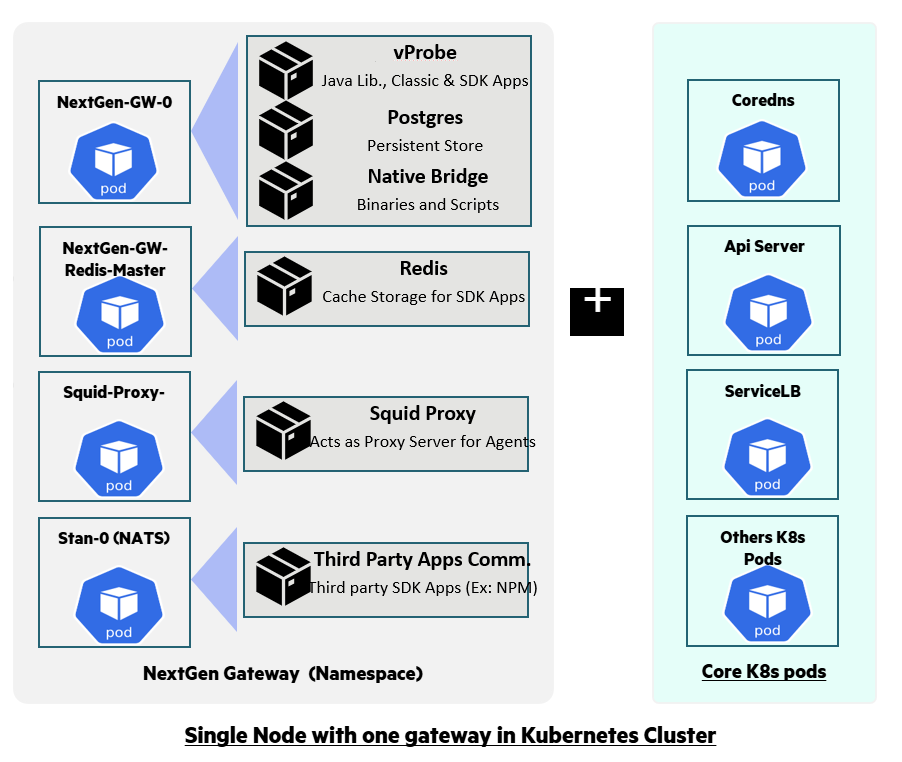
A high-level NextGen Gateway architecture is shown in the following diagram:
Key Components
NextGen Gateway runs as a pod in a k8s cluster within a namespace. It consists of the following key components:
- Vprobe: The core container of the gateway, responsible for discovery, monitoring, and scheduling tasks at regular intervals based on configuration. It also establishes connectivity to the cloud.
- Nativebridge: A helper container for the vprobe container that executes commands and scripts.
- Postgres: A helper container for the vprobe container that persists data.
- Squid Proxy (Optional): An optional pod that acts as a proxy for OpsRamp Agents, enabling them to securely establish outbound connectivity to the OpsRamp Cloud in restricted or proxy-based network environments.
- Redis: A helper pod that persists SDK apps data in cache, enabling faster data access and improved performance.
Key Features
The Key features of NextGen Gateway are:
High Availability
The NextGen Gateway ensures continuous discovery, monitoring, and alerting through its high-availability design.
- Supports clustered deployments by installing gateways on multiple nodes for fault tolerance.
- If a node becomes unavailable in the cluster, then the gateways are automatically routed to another active node, ensuring uninterrupted operations.
Scalability
- Supports horizontal scaling by deploying multiple Gateway replicas using elastic profile feature.
- Uses elastic profiles to balance workloads, distributing traffic across replicas when demand increases/decreases.
Zero-Touch Onboarding
- Simplifies onboarding with automated credential creation, discovery profiles, and integrations.
- Uses YAML-based configuration for quick, low-effort onboarding.
Multi-Tenancy
- Allows registration of multiple Gateways across different tenants within a single cluster.
- Ensures operational isolation while maintaining scalability and flexibility.
Deployment with Bootstrap Tool
To simplify installation and configuration, the NextGen Gateway leverages a cross-platform bootstrap tool.